June 15, 2026
How to Plan a Leaflet Delivery Campaign
Learn how to plan a leaflet delivery campaign that targets the right homes, controls costs and gives your…
Read article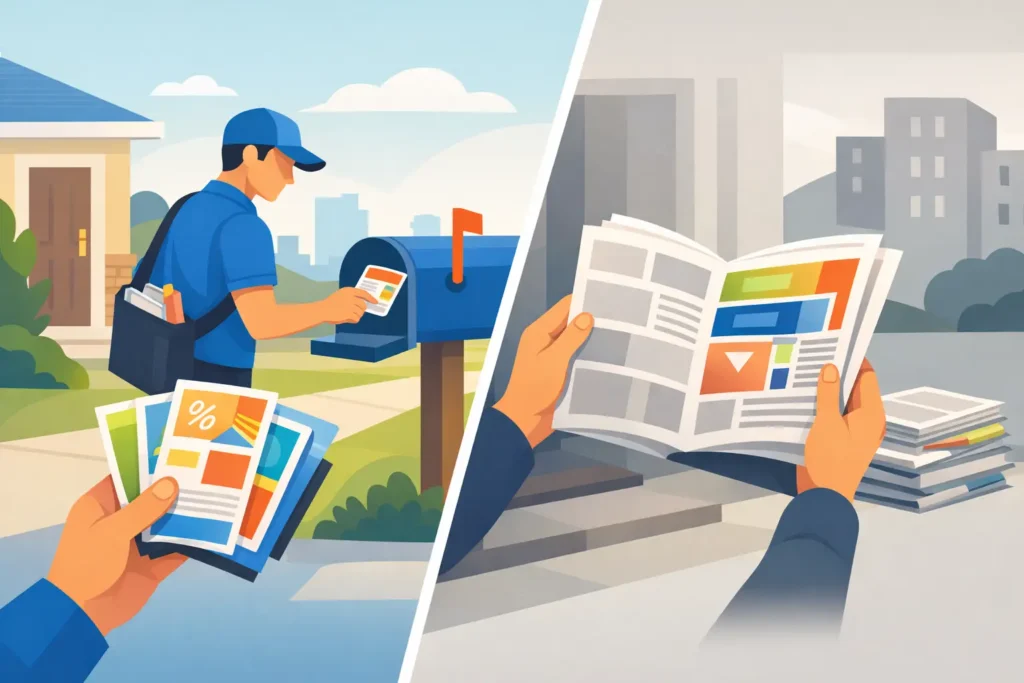
A local campaign can look good on paper and still underperform if the delivery method is wrong. That is the real issue in the flyer delivery vs newspaper inserts decision. You are not just choosing how a leaflet gets through a door. You are choosing how visible it is, how targeted it can be and how much control you keep over your spend.
For local businesses, that choice affects response rates more than the design alone. A well-printed offer delivered to the right homes at the right time will usually outperform a better-looking piece sent out in the wrong format. That is why it pays to look at the practical differences before booking a print run.
Flyer delivery usually means your marketing material is posted directly through the letterbox, either on its own or alongside a small number of other leaflets. The household receives it as a separate item, which gives it a clear chance to be noticed.
Newspaper inserts are different. Your flyer is placed inside a local newspaper or free publication and delivered as part of that bundle. In that setup, your leaflet is competing with the newspaper itself, any other inserts and whatever the resident normally does with free print material when it lands on the mat.
That difference sounds small, but in practice it changes how your message is seen. With direct flyer delivery, your leaflet stands on its own. With newspaper inserts, it is one item inside another item.
If your aim is immediate attention, flyer delivery usually has the stronger case. A leaflet delivered directly through the door is handled as its own piece. The resident sees the size, colour and branding straight away. Even if they do not read every word, they still register the business name and offer.
With newspaper inserts, visibility depends on whether the paper is opened and how far the person looks through it. Some households will read local papers carefully. Others will put them aside, recycle them or skim them quickly. If your insert slips out with a stack of other material, it can be ignored before your headline has done any work.
This does not mean newspaper inserts never perform. They can work well for broad awareness, especially where readership is consistent and the publication has a trusted local presence. But if you are promoting a time-sensitive offer, a launch, or a service that depends on quick action, direct flyer delivery gives you fewer barriers between the leaflet and the reader.
For many businesses, targeting matters more than volume. A plumber, estate agent, takeaway, childcare provider or local gym does not need blanket coverage across a wide region. They need the right streets, the right postcodes and the right type of household.
That is where flyer delivery is usually more flexible. Campaigns can be planned around postcode sectors, neighbourhoods and quantities that fit your budget. If you only want to reach selected parts of PE1 to PE7, that can be organised with far more control than a newspaper insert tied to a publication route.
Newspaper inserts are often limited by where that publication circulates. If the paper goes to areas outside your catchment, you may end up paying for reach you do not need. If it misses streets you want, there may be little you can do about it. For businesses that want tight local coverage rather than general exposure, that lack of control can be expensive.
At first glance, newspaper inserts can look cost-effective. The distribution infrastructure already exists, so pricing may appear attractive on a per-item basis. That can suit campaigns where the goal is simple visibility across a broad audience.
But low unit cost does not automatically mean better value. If a cheaper insert reaches households outside your target area, or if fewer people actually notice it, the headline saving can disappear quickly. A campaign should be judged on usable response, not just delivery volume.
Flyer delivery can cost more depending on the format, area selection and whether the leaflet is delivered solo or shared. Even so, it often gives stronger value because the campaign is more deliberate. You are paying for direct household access, clearer presentation and tighter control over where the material goes.
For a business watching every pound, the better question is not which option is cheapest. It is which option is more likely to generate enquiries from the households that matter.
Print advertising only works if the material is actually delivered properly. That sounds obvious, but it is one of the main concerns businesses have when booking any physical campaign.
With flyer delivery, the quality of the distribution company matters a great deal. You need reliable route planning, clear coverage, sensible scheduling and proof that the campaign has been carried out as agreed. When those systems are in place, direct distribution becomes a very accountable form of local marketing.
With newspaper inserts, advertisers often rely on the newspaper’s existing network and accept less direct visibility into the process. That may be fine for some campaigns, but it can leave you with fewer ways to verify the detail of where and when inserts were delivered.
For businesses that want confidence in local coverage, especially when running repeat campaigns, accountability is not a side issue. It is part of the result.
There are cases where newspaper inserts are a reasonable option. If your audience overlaps strongly with regular local paper readers, and your message is more about awareness than urgency, inserts can support a wider branding campaign.
They may also suit offers linked to community events, local retail promotions or services aimed at an older readership that is more likely to spend time with printed publications. In those cases, the context of appearing inside a familiar local paper can add some credibility.
The trade-off is that you give up some visibility and targeting precision. If you are comfortable with that, and the publication reach matches your market closely, inserts can still play a role.
Flyer delivery tends to be the better fit when your campaign needs clear local targeting and a measurable response. That includes trades, home services, takeaways, estate agencies, dentists, gyms, schools, care providers and event promotions.
It also makes more sense when you want to test one area before expanding, repeat activity in selected postcodes, or match a distribution plan to seasonality. If you are promoting boiler servicing before winter, garden work in spring, or a limited-time offer for new customers, direct delivery gives you more control over timing and geography.
For many SMEs, that control is what turns print from a general branding exercise into a lead-generation channel.
If your main goal is brand presence across a broad local audience, newspaper inserts may do enough. They can put your name in front of many households at once, particularly where publication readership is reliable.
If your goal is enquiries, bookings or store visits from specific areas, flyer delivery usually has the edge. It is more direct, easier to target and less dependent on reader behaviour. Your leaflet arrives as a standalone marketing piece, not as something tucked inside another product.
That distinction matters because response often comes from attention first, then relevance. Direct delivery improves your chances on the attention side.
The right choice depends on what you are selling, where your customers are and how tightly you need to manage your budget. If you only need broad awareness and the newspaper coverage matches your market well, inserts may be enough.
If you need better control, clearer visibility and stronger confidence that your material reaches selected households, flyer delivery is usually the safer commercial decision. It gives you more say over area selection, quantity and delivery format, which is exactly what most local businesses need when every campaign has to justify itself.
That is why many advertisers treat newspaper inserts as a supporting option, while relying on direct leaflet distribution for the core campaign. One is broader and less precise. The other is built for local targeting and practical response.
If you are weighing up both, start with the outcome you need rather than the format you recognise. The best print campaign is the one that reaches the right homes, gets noticed and gives you a fair shot at a return.
Ready to plan your next leaflet campaign?
Get a Free Quote
Learn how to plan a leaflet delivery campaign that targets the right homes, controls costs and gives your…
Read article
Compare cheap leaflet distribution options for local campaigns, from shared delivery to postcode targeting, and spend less without…
Read article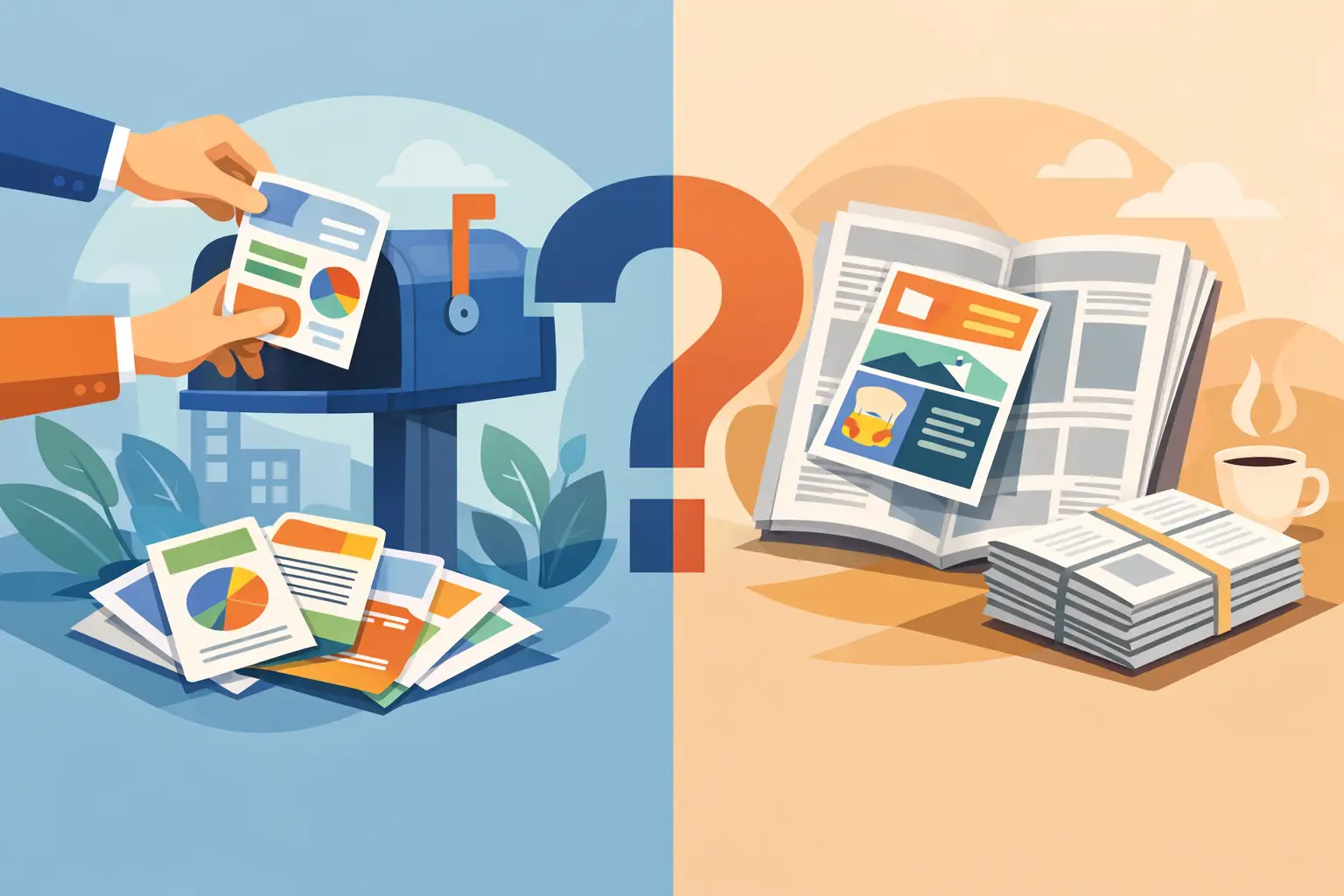
Shared leaflets or newspaper inserts can both cut costs, but the right choice depends on targeting, timing, visibility…
Read article