
June 12, 2026
Shared leaflets or newspaper inserts?
Shared leaflets or newspaper inserts can both cut costs, but the right choice depends on targeting, timing, visibility…
Read article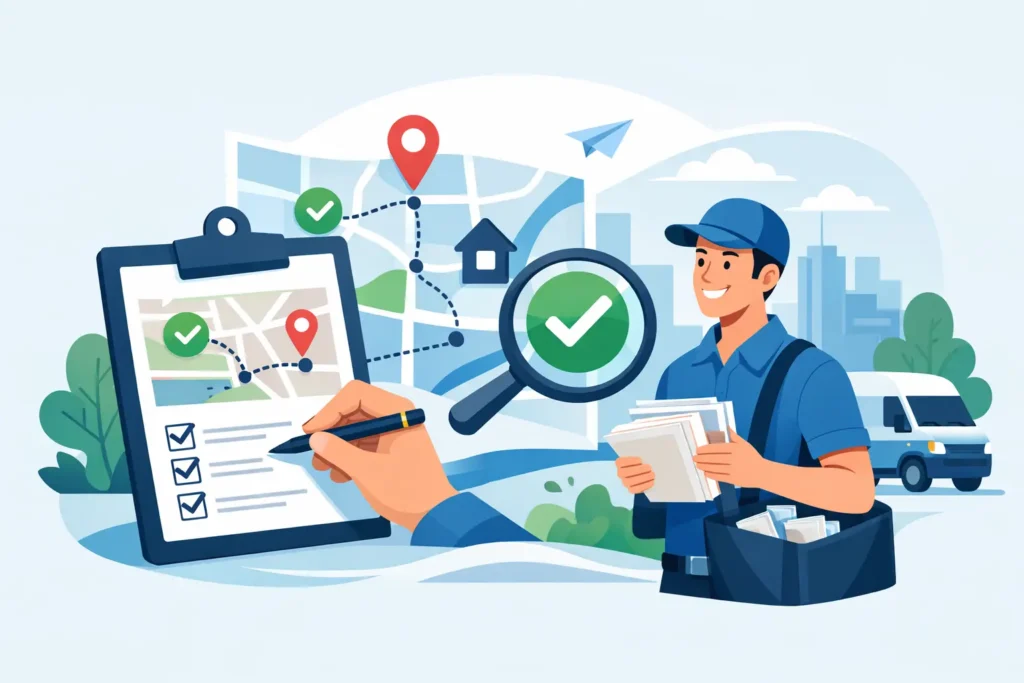
If you are paying for print, design and distribution, you need to know one thing above all else – were your leaflets actually delivered where they were meant to go? That is why verified leaflet delivery routes matter. They turn leaflet marketing from a hopeful spend into a channel you can plan, track and trust.
For many local businesses, the problem is not whether leaflet advertising can work. It can. The real issue is confidence. If you are promoting a seasonal offer, a new opening, a service area expansion or a time-sensitive event, wasted coverage costs money twice. You lose the print budget, and you lose the chance to generate enquiries from the right households.
Verified leaflet delivery routes are planned delivery rounds that can be checked and reported against. In simple terms, they give structure and accountability to a campaign. Instead of vague promises about area coverage, you have a defined route, selected streets or postcode sectors, and a record that the delivery has been carried out.
That matters because not all distribution is equal. Some campaigns are broad and built for reach. Others need tighter local targeting, especially for trades, estate agents, healthcare providers, takeaways, gyms, schools or event organisers working within a clear catchment. If the route is not verified, it is harder to trust the result, harder to repeat what worked and harder to improve what did not.
A verified route does not mean every campaign will produce identical returns. Response always depends on the offer, the design, the timing and the area. What it does mean is that the delivery side of the campaign is being managed properly rather than left to assumption.
Leaflet marketing still works because it puts your message directly into homes. But it has always had one obvious concern attached to it – trust. Business owners know that once boxes of printed leaflets leave their hands, visibility drops. If there is no proper route planning or reporting, they are relying on faith.
That is where many campaigns fall short. The print may be good. The offer may be strong. The geography may be right. Yet if the delivery process is weak, the whole campaign is undermined.
Verified leaflet delivery routes deal with that head on. They give you a more accountable way to run a campaign, especially when you are investing in quantity and targeting specific neighbourhoods. For a local business trying to generate calls, bookings or footfall, that level of confidence is not a nice extra. It is part of the service.
A leaflet campaign should never be treated as a blanket exercise unless broad awareness is the only goal. Most businesses have a much clearer brief than that. They want to reach owner-occupiers in selected residential areas, homes near a branch, households in a postcode with the right spending profile, or streets close to a venue before an event.
Verified routes support that level of planning. You can choose areas based on where your customers already come from, where you want more coverage, or where a service team can respond quickly. That makes a major difference to efficiency.
A plumber covering selected parts of Peterborough does not need waste in streets outside the practical service area. A local restaurant promoting a menu launch does not need to reach households too far away to order. A gym opening a new site wants strong saturation nearby before expanding outward. In each case, the route matters as much as the leaflet itself.
When routes are verified, campaign decisions become easier to make. You can test one postcode sector, assess response, then scale into nearby areas. You can support a one-off promotion with tighter distribution or build repeated coverage over time in the same neighbourhoods.
This is where local knowledge also comes into play. Streets are not all equal. Density, housing type, access and catchment behaviour all affect planning. A provider with experience in PE1 to PE7 can make more practical decisions about route structure than a generic service working from a national template.
Some businesses look at verification purely as a reassurance measure. It is that, but it also improves value. A campaign with clear route planning and transparent reporting is easier to assess commercially.
You can compare one area against another. You can measure response against quantity. You can decide whether solo delivery is worth the extra spend for a premium offer, or whether shared distribution is the right fit for a wider awareness campaign. Without route verification, those decisions are less grounded.
There is also a simple budgeting point here. Most businesses are not running print campaigns for the sake of visibility alone. They want bookings, calls, website visits or store traffic. If the delivery is not accountable, your cost per enquiry becomes harder to judge. Verified routes make the channel more measurable, even if print will never behave exactly like paid search or social advertising.
Not every business will define verification in the same way, so it is worth asking direct questions. How are areas planned? What reporting is provided after the campaign? Can quantities be matched to the selected geography? Is there a clear difference between shared and solo distribution? These are practical questions, not technical ones.
You should also look at how the company talks about delivery. If the service description is vague, that usually tells you something. A dependable provider should be able to explain the route plan, the area logic and the delivery format in plain language.
Experience matters too, but only if it is backed by process. A firm that has been distributing leaflets for years should have a clearer operational approach, not just a longer trading history. The best providers make campaign planning straightforward. They help you choose the right area, the right quantity and the right distribution type without overcomplicating the job.
There is a trade-off worth being honest about. Verified leaflet delivery routes improve accountability, but they do not fix weak marketing. If the design is cluttered, the offer is poor or the message is aimed at the wrong audience, delivery proof will not rescue the result.
That is why the strongest campaigns get the basics right first. The leaflet needs a clear offer, a strong call to action and a reason to respond now. The targeting then makes that message more efficient. Verification gives you confidence that the message reached the intended homes.
It also helps to match the campaign type to the objective. A shared distribution campaign may be the sensible option for cost-conscious area coverage. A solo campaign may be better when timing, visibility and brand impact matter more. Neither is automatically better. It depends on what you are trying to achieve and how competitive the message is.
Some campaigns can absorb a bit of uncertainty better than others. A long-term brand awareness push across several areas may not depend on one precise delivery window. But many local campaigns are much less forgiving.
If you are launching a new service, promoting a limited-time offer, supporting a local event or trying to dominate a defined patch, verification becomes far more important. The tighter the objective, the more you need confidence in the route.
This is especially true for businesses that operate within strict service boundaries. If your team covers selected postcodes, or if travel time affects your margin, there is no point paying to reach households outside your workable area. Verified delivery routes protect against that kind of waste.
For that reason, businesses using PB Leaflet Distribution often see verification not as an added feature, but as part of sensible campaign planning. It supports trust, improves control and gives the client a clearer basis for the next decision.
Leaflet marketing does not need hype. It needs proper planning, the right area, the right quantity and proof that the job has been carried out. That is what verified leaflet delivery routes bring to the table.
They help you spend with more confidence, target homes more accurately and judge results on something firmer than assumption. For local businesses that want direct household reach without wasting print or coverage, that makes a real commercial difference.
If you are going to put your brand through letterboxes, make sure the route is as reliable as the message.
Ready to plan your next leaflet campaign?
Get a Free Quote
Shared leaflets or newspaper inserts can both cut costs, but the right choice depends on targeting, timing, visibility…
Read article
A leaflet campaign results example that shows what good response rates look like, what affects performance, and how…
Read article
Leaflet delivery or digital ads? Compare cost, targeting, trust and response rates to choose the right local marketing…
Read article