
June 17, 2026
9 Top Sectors for Leaflet Marketing
See the top sectors for leaflet marketing and where door-to-door campaigns deliver strong local response, better targeting and…
Read article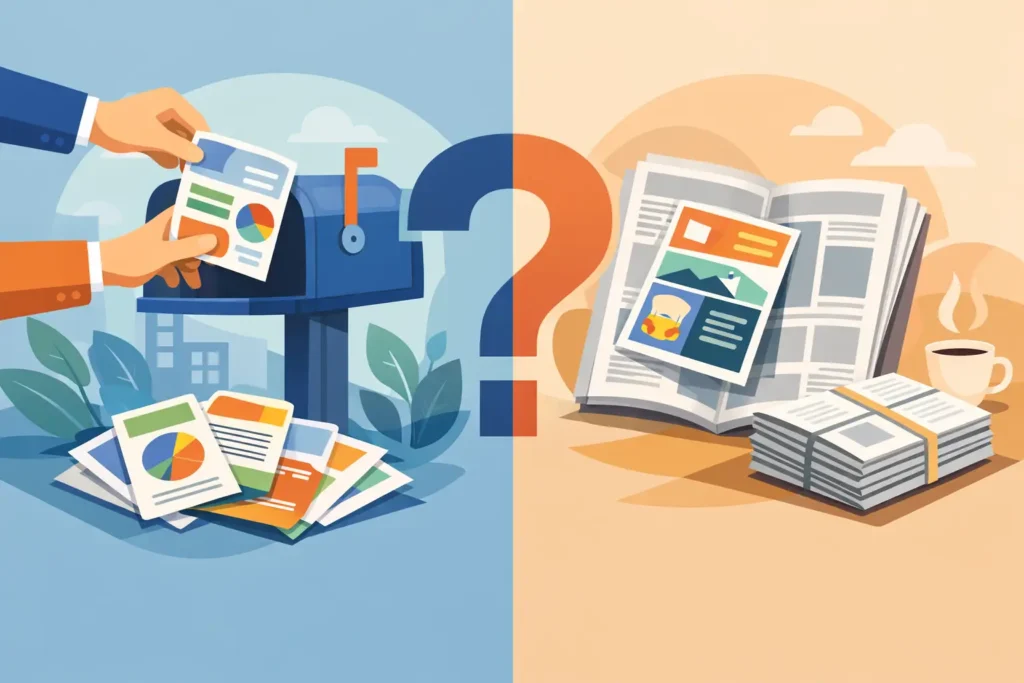
When budget matters but reach still needs to be strong, shared leaflets or newspaper inserts are usually the two print options businesses compare first. On paper, both can look like sensible, lower-cost ways to get in front of local households. In practice, they work differently, and the best choice depends on what you are promoting, who you need to reach, and how much control you want over delivery.
For a local business, that difference is not minor. If you are paying for print and distribution, you need to know whether your message is likely to be noticed, whether it is landing in the right homes, and whether the campaign format suits the offer. That is where many decisions are won or lost.
Shared leaflet distribution means your leaflet is delivered with other non-competing items as part of a planned household distribution round. It is a cost-effective format because the delivery cost is spread across several advertisers, but the item still arrives directly at the property as part of a dedicated distribution activity.
Newspaper inserts place your leaflet inside a local newspaper or publication before it reaches the reader. That can sound similar at first glance, but the route to the household is different. Your leaflet relies on the newspaper being purchased, received or picked up, then opened, then read closely enough for the insert to be noticed.
That distinction matters. A shared leaflet campaign is built around getting promotional material through the door. A newspaper insert campaign is built around piggybacking on another product. If the publication performs well with your target audience, inserts can work. If it does not, your leaflet is tied to a weaker vehicle from the start.
Shared distribution is often the better fit when your main aim is broad local coverage at controlled cost. For many trades, local services, takeaways, estate agents, care providers, gyms and event organisers, the goal is simple – get a clear offer into as many relevant homes as possible without paying for a solo campaign.
That is where shared delivery earns its place. You still reach households directly, but at a lower rate than a dedicated single-client round. If your leaflet is well designed, includes a clear offer and targets the right area, shared campaigns can generate steady enquiry without overspending.
This approach also gives you more freedom to target by postcode sector or neighbourhood. That is useful if you only cover certain catchment areas, want to focus on likely customer density, or need to build awareness in one part of town before expanding further. For businesses working across places such as PE1 to PE7, area selection is often just as important as the leaflet itself.
Newspaper inserts can still suit some campaigns. If your audience has a strong habit of reading a particular local title, and that title has credible circulation in the exact areas you want, inserts may help you piggyback on established reader behaviour.
They can make sense for older demographics, community-led promotions, local retail offers or messages that benefit from appearing alongside familiar local editorial content. In some cases, the newspaper adds a degree of recognition that helps the insert feel less random.
But there is a trade-off. Your leaflet is sharing attention not only with other inserts, but with the newspaper itself. If the publication goes unread, your insert goes unread with it. If households discard free papers quickly, the chances of engagement fall. That does not make inserts ineffective by default, but it does mean performance depends heavily on the strength of the publication.
The biggest practical difference between the two formats is visibility. A shared leaflet delivered directly with other promotional items is more likely to be seen as part of a household’s usual post and print handling. It is there in plain sight.
A newspaper insert may be tucked inside pages, folded into the publication, or removed without much attention. Some readers go straight to the section they want and skip the rest. Others recycle the paper unread. If your campaign depends on immediate visual impact, that lower visibility can be a problem.
For time-sensitive promotions, this point becomes even more important. If you are advertising a launch, seasonal offer, local event or limited booking window, you need households to notice the leaflet quickly. Shared delivery often gives you a better chance of that because the item is not relying on newspaper reading habits to do the heavy lifting.
Businesses rarely ask for print distribution because they want vague exposure. They want coverage in the right places and they want confidence that the job has been done properly.
This is where shared leaflet campaigns often hold an advantage. Dedicated distribution companies can plan rounds by postcode sector, quantity and delivery schedule, which gives you more control over where your leaflet goes. If you only want selected areas, or you want to avoid wasting stock outside your service radius, that control matters.
Newspaper inserts are often tied to publication circulation rather than a custom delivery plan. That can reduce flexibility. You may be buying into the footprint of the paper, not building a campaign around your actual trading area.
Accountability also needs a realistic look. In print marketing, trust is a commercial issue, not just a customer service issue. If there is no clear route planning or reporting, lower headline costs can stop looking like value very quickly. Reliable distribution matters because every 1,000 leaflets printed and placed represents real spend.
A lot of businesses compare shared leaflets or newspaper inserts on price alone. That is understandable, but it is not the right way to judge them.
A cheaper format is only better if it produces useful response. If newspaper inserts cost slightly less but generate weaker visibility or less relevant local reach, the lower rate can become false economy. Equally, if a shared leaflet campaign costs more than an insert run but gives better targeting and stronger household attention, it may deliver better value overall.
The right question is not only, “What does this cost per thousand?” It is also, “What am I paying for in terms of reach, control and response potential?”
For many local advertisers, especially those tracking calls, bookings or offer redemptions, that distinction becomes clear quite quickly. A campaign that reaches the right homes consistently tends to outperform one that simply looks efficient on a rate card.
If you are promoting a straightforward local service with a clear call to action, shared distribution is often the safer option. It suits messages such as free quotes, introductory offers, seasonal reminders, opening announcements and area-based services where broad residential coverage matters.
If your campaign is more editorial in nature, tied to a publication audience, or aimed at readers who are likely to engage with local papers in detail, inserts may have a place. But that depends on the publication genuinely matching your customer base.
The format should also match the strength of your leaflet. If your design has a bold offer, strong headline and quick-read message, direct household delivery usually supports that well. If your message needs more context and is likely to benefit from being encountered within a newspaper-reading setting, inserts can be considered.
Start with your trading area. If you need reliable coverage in specific neighbourhoods, shared distribution usually gives you more practical control. Then look at your offer. If it is time-sensitive, visually driven or based on quick response, direct shared delivery tends to be the stronger option.
After that, consider your audience habits honestly. Not every household reads local newspapers, and readership can vary sharply by age, area and publication type. If you cannot say with confidence that your buyers are active readers of that paper, inserts become harder to justify.
Finally, think about proof and planning. A campaign is easier to manage when routes, quantities and timing are clear from the outset. That is one reason many businesses choose specialist providers such as PB Leaflet Distribution for shared campaigns rather than relying on a newspaper vehicle that offers less flexibility.
Shared leaflets and newspaper inserts both have their place, but they are not interchangeable. If you want direct local exposure, practical area targeting and a format built around household delivery rather than publication readership, shared distribution is often the stronger commercial choice. The best campaigns are usually the simplest ones – get the right message into the right homes, at the right time, and make it easy for people to respond.
Ready to plan your next leaflet campaign?
Get a Free Quote
See the top sectors for leaflet marketing and where door-to-door campaigns deliver strong local response, better targeting and…
Read article
Choosing door to door leaflet distribution companies? Learn what matters most - targeting, proof of delivery, pricing and…
Read article
Leaflet distribution PE2 for businesses that want reliable local reach, targeted delivery and clear reporting to make every…
Read article