May 23, 2026
What Is Solo Leaflet Distribution?
What is solo leaflet distribution? Learn how it works, when to use it, and why it can deliver…
Read article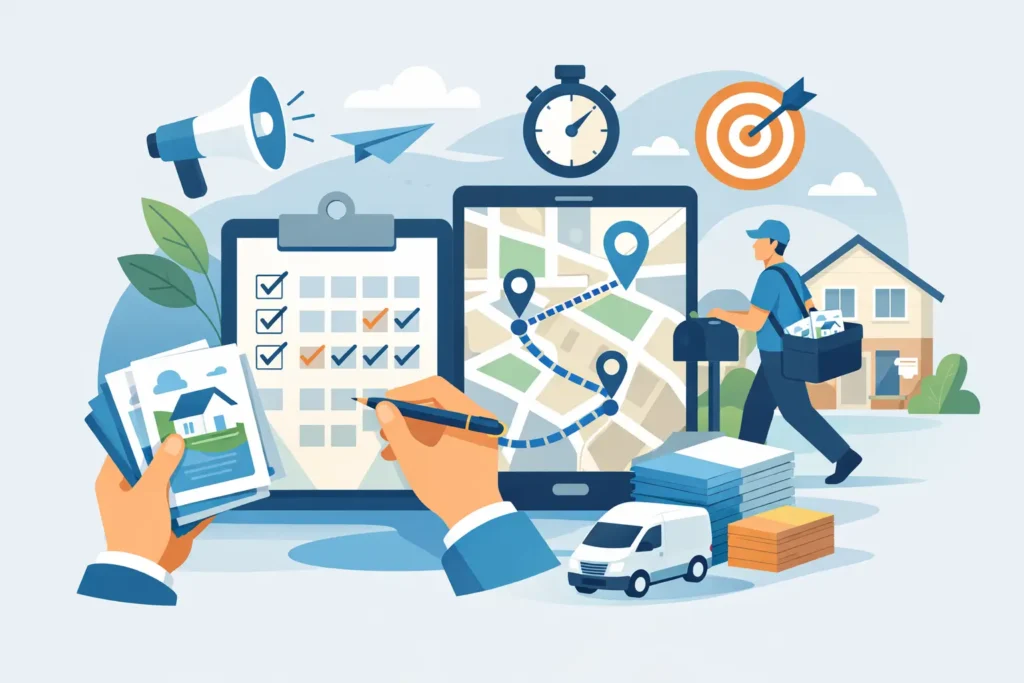
A leaflet campaign can waste money very quickly if you send too many pieces to the wrong homes, at the wrong time, with the wrong offer. If you want to plan a leaflet delivery campaign properly, the job starts well before anything is printed or booked for distribution.
The businesses that get the best return from leaflet marketing usually do three things well. They target carefully, match volume to the size of the opportunity, and use a delivery plan they can trust. Everything else follows from that.
Before you choose areas or quantities, get clear on what the campaign needs to achieve. That sounds obvious, but plenty of businesses begin with a number such as 5,000 or 10,000 leaflets simply because it feels like a sensible amount. That is not a plan. It is a print quantity.
A better starting point is the commercial goal. You might want more quote requests for a local trade service, stronger awareness for a new opening, extra bookings during a quiet month, or attendance for an event. Each of those goals affects how you should plan the campaign.
If you are pushing a time-sensitive offer, timing and repeat exposure matter more than broad coverage. If you are launching in a new area, reach may matter more than frequency at first. If you are promoting a service with a higher average job value, solo distribution may justify the extra spend because each response is worth more.
The quickest way to weaken a campaign is to target everyone. Good leaflet marketing is local, but it still needs selectivity. The fact that a household is nearby does not automatically make it a good prospect.
Think about who is most likely to respond. A family-focused offer may perform better in dense residential areas with steady household turnover. A premium home improvement service may need more selective postcode planning. A takeaway menu, local gym launch or childcare promotion will each have a different pattern of demand.
This is where area knowledge matters. Looking at postcode sectors and simply choosing the nearest streets is rarely enough. You want an area mix that fits your service radius, your likely customer profile and your budget. In Peterborough and surrounding postcode areas, that can mean building a campaign around practical clusters rather than trying to cover everything in one go.
There is always a trade-off between coverage and precision. Wider coverage gets your name in front of more households, but it can dilute spend if too many of those homes are outside your best audience. Tighter targeting improves efficiency, but if you narrow too far you may limit response volume. The right balance depends on your service, margin and local demand.
When you plan a leaflet delivery campaign, the delivery method is not a minor detail. It has a direct impact on cost, visibility and response.
Shared distribution is usually the more cost-efficient option if the priority is reaching a good number of households at a controlled budget. It works well for general awareness, seasonal offers and campaigns where broad local presence matters.
Solo distribution is the stronger choice when you want maximum attention. If you are promoting a high-value service, a major launch or an offer where response quality matters more than raw reach, being the only item delivered can make a clear difference.
There is no universal best option. A plumber promoting emergency cover and a venue promoting an upcoming event may need completely different approaches. What matters is matching the format to the economics of the campaign.
One of the most common mistakes is treating leaflet distribution like a one-off test with an arbitrary number. In practice, quantity only makes sense when linked to area size and campaign purpose.
If you only cover a small section of your target market, you may not generate enough response data to judge performance properly. If you cover too much too quickly, you may spend heavily before learning which neighbourhoods respond best.
For many local businesses, phased distribution is the smarter option. Start with a manageable group of postcode sectors, measure response, then expand or refine. That gives you a better read on what is working without committing the whole budget at once.
A campaign can also benefit from repeat delivery. Households often need to see a business more than once before acting, especially for services they do not need immediately. A single round can work for urgent or highly attractive offers, but many businesses get better long-term value from consistent local presence over several weeks or months.
Even the best distribution plan cannot rescue a weak message. If the leaflet does not give people a clear reason to respond, targeting alone will not carry the campaign.
The strongest offers are usually simple and commercially clear. That might be a discount, a free quote, a limited-time package, a new customer incentive or a seasonal prompt. The main point is to remove hesitation. People should understand within seconds what you do, who it is for and what they should do next.
Do not overcrowd the leaflet with too many messages. Most local campaigns work better when they focus on one main action. If you try to promote every service, every price point and every benefit at once, the result often looks less convincing, not more.
Practical details matter as well. Your contact information should be easy to find. If you cover specific areas, say so. If speed, trust or reliability are part of the reason customers choose you, make that obvious. Clear beats clever in print marketing almost every time.
A well-designed leaflet delivered at the wrong moment can underperform. Timing affects both relevance and urgency.
Some campaigns are naturally seasonal. Garden services, home improvements, tutoring, events and takeaway promotions all have periods where household attention is higher. If your service has a peak demand window, work backwards from it. Allow time for design, print and distribution rather than trying to force a rushed campaign into the market.
There is also a practical timing question around customer behaviour. If you need a steady flow of enquiries, it is often better to schedule distribution in planned waves than to release everything in one burst. That can help smooth demand and make response easier to manage.
If your team can only handle a certain number of calls or bookings each week, that should shape the delivery schedule. More response is not always better if it arrives faster than the business can deal with it.
Leaflet marketing should be measurable, but measurement needs to be practical. Not every customer will tell you exactly where they heard about you, and not every response can be tracked with perfect precision.
Even so, you can still build a clear picture. Ask new enquiries how they found you. Use dedicated phone numbers or specific offer wording where appropriate. Track response by area and by delivery period. Over time, patterns appear.
The useful question is not whether every single lead can be attributed with absolute certainty. It is whether the campaign is creating enough commercial return to justify repeating, improving or expanding it.
This is another reason verified delivery matters. If you are trying to assess results, you need confidence that materials were distributed where and when agreed. Without that, poor response could be a targeting issue, a message issue or a delivery issue, and you have no solid basis for decision-making.
Trust is a practical issue, not a branding extra. When you pay for household distribution, you need confidence that your campaign is being handled properly.
That means clear area planning, realistic quantities, agreed timing and transparent reporting. It also means choosing a provider that understands local geography and does not overcomplicate the process. A dependable service should make it easier to decide where to target, how much to send and which format fits your budget.
For businesses across Peterborough and postcode areas such as PE1 to PE7, local knowledge can make planning far more efficient. Streets, estates and sector coverage are not just lines on a map. They affect reach, density and campaign value.
PB Leaflet Distribution works with businesses that want exactly that sort of clarity – targeted planning, reliable delivery and reporting that gives you confidence in where your budget has gone.
The best campaigns are rarely perfect on the first run. They improve because the business learns which areas respond, which offer gets attention and which delivery format suits the service.
That is why a leaflet campaign should be treated as a marketing channel, not a one-off gamble. If the fundamentals are right, each round gives you better information for the next one. You start to see which postcode sectors deserve more budget, where response needs a stronger offer, and whether repeat exposure is lifting enquiry levels.
A sensible plan is not about sending the most leaflets possible. It is about putting the right message in the right homes, with delivery you can rely on and a budget you can repeat if the numbers work. If you approach it that way, leaflet marketing becomes much easier to manage and far more likely to produce enquiries you can build on.
Ready to plan your next leaflet campaign?
Get a Free Quote
What is solo leaflet distribution? Learn how it works, when to use it, and why it can deliver…
Read article
Leaflet distribution for event promotion helps fill venues fast with targeted local reach, better timing and measurable response…
Read article
Use this Peterborough postcode advertising guide to choose areas, set quantities and run accountable household campaigns that generate…
Read article