
June 17, 2026
9 Top Sectors for Leaflet Marketing
See the top sectors for leaflet marketing and where door-to-door campaigns deliver strong local response, better targeting and…
Read article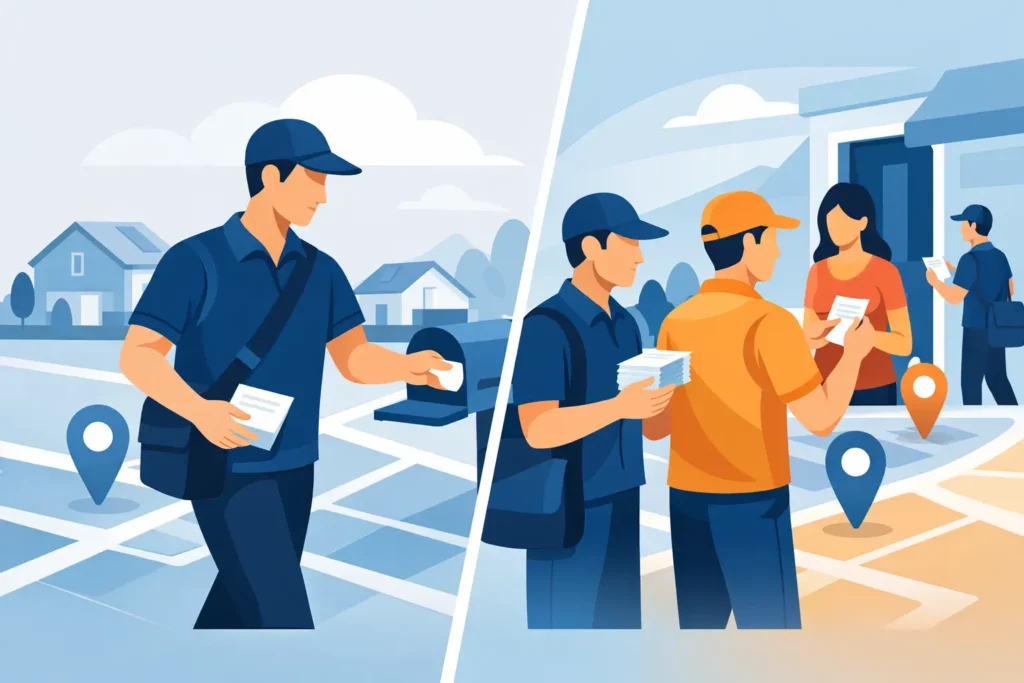
If you are planning a print campaign, the choice between solo vs shared leaflet distribution affects more than cost. It changes how visible your message is, how often households remember you, and how tightly you can control the result. For some businesses, paying more for exclusive delivery makes sense. For others, shared distribution gives better coverage for the same budget.
The right option depends on what you are promoting, who you need to reach and what result you expect from the campaign. If you treat both formats as interchangeable, you can easily spend too much or aim too low.
Solo distribution is exactly what it sounds like. Your leaflet is delivered on its own, with no other advertising material alongside it. When a household picks it up, your business has their full attention for that moment.
Shared distribution means your leaflet is delivered as part of a bundle with other non-competing leaflets. It is a more cost-efficient format because delivery costs are spread across several advertisers. You still reach homes directly, but you share space and attention.
Neither option is automatically better. The question is whether you need maximum impact per household or broader reach for the same spend.
Solo delivery is usually the stronger choice when the campaign has a high value outcome. If one new customer is worth a good amount to your business, paying more for stronger visibility can be a smart decision.
This applies to trades, home improvement firms, estate agents, private healthcare providers, education services and any business where a single enquiry can turn into significant revenue. If a new job is worth hundreds or thousands of pounds, it makes sense to improve the odds that your leaflet is noticed.
Solo distribution also suits time-sensitive promotions. If you are launching a new service, promoting an event, announcing an opening or running a seasonal offer with a clear deadline, you do not want your message competing with several other flyers on the doormat. The cleaner the presentation, the stronger the recall.
There is also a brand perception point. A well-designed leaflet delivered on its own often feels more established and more deliberate. For businesses trying to look premium, trusted or specialist, that matters.
Shared distribution is often the best fit when your priority is coverage. If you want to get your name in front of a larger number of homes while keeping costs under control, shared campaigns can work very well.
This suits takeaway menus, gyms, local retailers, cleaning services, community promotions, tutoring, childcare, beauty services and many start-ups trying to build awareness in a defined area. If your offer has broad appeal and your response model relies on consistent local visibility, reach matters.
Shared distribution is also useful when you are testing. Many businesses do not yet know which neighbourhoods, offers or leaflet designs will produce the best return. In that case, it can be sensible to start with a more economical campaign, measure response, and then put more money behind the areas or messages that perform best.
For repeat advertising, shared delivery can be especially effective. One leaflet on its own might be missed. Repeated exposure across several weeks or months often builds familiarity, and familiarity helps response.
A lot of businesses ask the same question: which format gets the better response rate?
On a like-for-like basis, solo distribution will often produce stronger visibility and, in many cases, a better response rate per 1,000 homes. That does not mean it always gives the best return on investment. If shared distribution lets you reach significantly more households for the same budget, total enquiries may still be higher overall.
That is why response rate on its own is not enough. You need to look at cost per enquiry and cost per customer.
Take a simple example. A solo campaign may cost more and bring in 20 strong enquiries from 5,000 homes. A shared campaign might bring in 24 enquiries from 10,000 homes at a similar total spend. The shared option has a lower response rate per household, but a better outcome for total lead volume. On the other hand, if your average sale is high and those solo leads are better qualified, solo may still be the better commercial decision.
This is where campaign planning matters. It is not just about what gets seen. It is about what produces profitable work.
Format matters, but targeting matters just as much.
A solo leaflet delivered to the wrong homes is still wasted spend. A shared leaflet delivered to the right households can outperform a poorly planned exclusive campaign. Area selection, housing type, likely customer profile and quantity all shape the result.
For a local business working across Peterborough and surrounding postcode sectors such as PE1 to PE7, this can make a real difference. A trades business might do well in owner-occupied estates. A children’s activity provider may get better traction in family-heavy areas. A premium service may need tighter postcode selection rather than blanket coverage.
The best campaigns match the format to the audience. If the audience is highly relevant and the value of each customer is strong, solo often works well. If the audience is broad and the goal is local presence at scale, shared can be the better fit.
Many businesses make the mistake of putting the whole budget into one large push without thinking about frequency. In print marketing, one appearance is not always enough.
If your budget is limited, shared distribution can give you room to run multiple waves instead of a single hit. That repeated presence can be more valuable than one premium campaign, especially for everyday local services where customers may not need you immediately but will remember you later.
Solo distribution is often better when timing is critical and the message needs immediate attention. Shared distribution is often better when you want to maintain visibility over time.
There is no fixed rule here. A higher-ticket service might benefit from one well-targeted solo campaign followed by a lower-cost shared reminder in the same area. A business with a regular consumer offer may get better results from steady shared coverage month after month.
Before you book anything, be clear on four things: the value of a new customer, the urgency of the offer, the size of the target area and how many times you are prepared to appear in front of the same households.
If customer value is high, urgency is strong and brand presentation matters, solo delivery usually deserves serious consideration. If customer value is lower, the audience is wider and repeat exposure is part of the plan, shared distribution is often the more efficient option.
You should also consider operational trust. Reliable delivery, verified routes and clear reporting are just as important as format. A cheaper campaign is not better value if you cannot be confident it was carried out properly. That is one reason businesses choose experienced providers such as PB Leaflet Distribution when they want local targeting backed by accountability.
Choose solo when every impression counts and you need your leaflet to stand on its own. Choose shared when cost control, reach and repeat presence are more important than exclusivity.
For many businesses, the best answer is not one or the other forever. It is using each format where it makes commercial sense. A launch, premium service or key seasonal offer may justify solo distribution. Ongoing awareness building may be better handled through shared campaigns.
The strongest leaflet campaigns are rarely built on guesswork. They are built on clear local targeting, realistic budgeting and a delivery format that fits the job. If you get that part right, your print marketing has a much better chance of bringing in the kind of response that makes the numbers work.
Before your next campaign goes to print, think less about which option sounds better and more about which one gives your business the better chance of turning households into enquiries.
Ready to plan your next leaflet campaign?
Get a Free Quote
See the top sectors for leaflet marketing and where door-to-door campaigns deliver strong local response, better targeting and…
Read article
Leaflet distribution PE6 for local businesses that want reliable delivery, postcode targeting and better response from every campaign.
Read article
A leaflet campaign results example that shows what good response rates look like, what affects performance, and how…
Read article