
June 5, 2026
Leaflet Campaign Results Example That Makes Sense
A leaflet campaign results example that shows what good response rates look like, what affects performance, and how…
Read article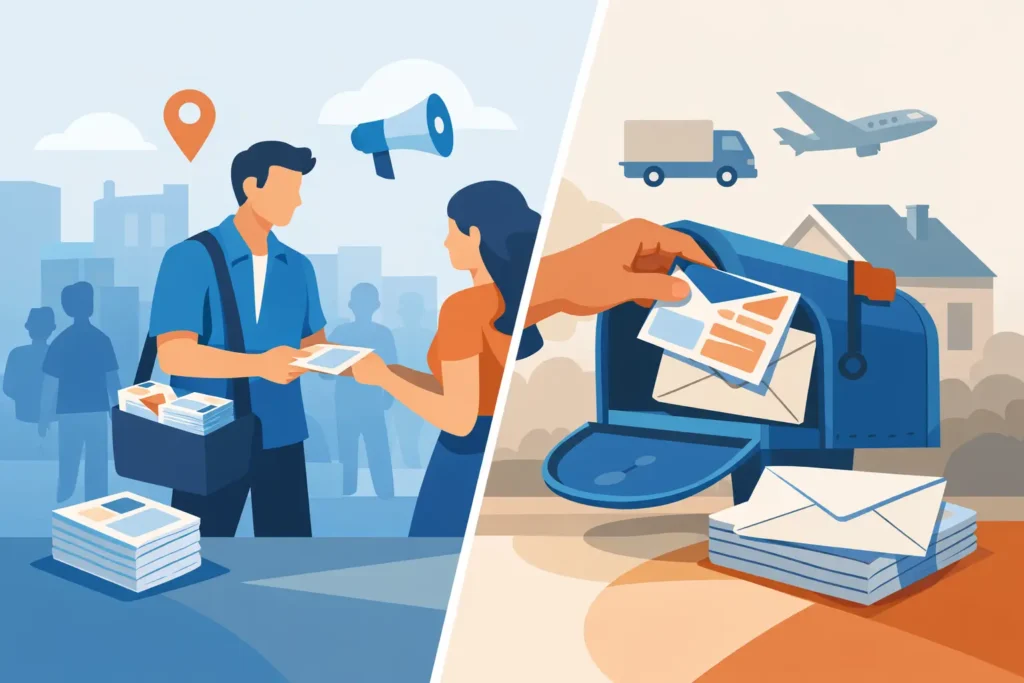
If you are weighing up flyer distribution vs direct mail, the real question is not which one sounds more professional. It is which one gives your business the best return for the area, budget and response you need. For a local campaign, that difference matters. A poorly chosen print method can waste stock, time and money. The right one can put your offer in front of the households most likely to act.
Both methods are designed to get printed marketing into homes. That is where the similarity ends. One is usually built for broad local coverage at a lower cost per household. The other is built for tighter targeting, personalisation and a higher cost per item. If you run a local service business, promote events, or want steady enquiry volume from specific neighbourhoods, understanding that trade-off will help you spend more confidently.
Flyer distribution is generally a door-to-door delivery service. Your leaflet, flyer or folded brochure is distributed to homes in selected streets, postcode sectors or neighbourhoods. It is a strong option when your goal is visibility across a local area and you want to reach a high volume of households for a sensible cost.
Direct mail usually means sending printed marketing through the postal system to named individuals or selected addresses. It often involves purchased or existing address data, postage costs and more production complexity. It can feel more precise, but that precision comes at a price.
For many local firms, the choice comes down to this. Do you need broad household reach in a target area, or do you need a personalised message to a narrower list?
Flyer distribution works well when location matters more than identity. A plumber covering selected parts of Peterborough, a takeaway launching in a new delivery radius, or a gym promoting an opening offer usually cares most about reaching households nearby. They do not necessarily need the resident’s name. They need the right streets.
This is where area targeting gives you a practical advantage. You can select the neighbourhoods that fit your service range, price point or customer profile, then build your quantity and timing around that. If one area performs well, you can repeat it. If another area underperforms, you can adjust the next campaign without redesigning the whole strategy.
The biggest attraction is cost efficiency. Without individual postage on every item, flyer distribution tends to be far more affordable per household than direct mail. That allows smaller firms to get proper local coverage rather than limiting themselves to a small data list.
There is also a frequency benefit. Most print campaigns do not work because a single piece of paper lands on a mat once. They work because households see your brand repeatedly. If your budget allows three rounds of area distribution instead of one expensive postal mailing, the cheaper format can often produce better real-world results.
Direct mail has strengths that flyer distribution does not try to copy. If you have a strong customer database, need to speak to previous buyers, or want to send a highly tailored message, direct mail can be the better tool.
A financial service firm, estate agent or school might need a more formal format with named recipients, segmented offers or follow-up communication linked to existing records. In those cases, the extra cost can be justified because the audience is already qualified.
Direct mail can also suit high-value sales where even a low response rate still delivers a strong return. If one conversion is worth a significant amount, spending more per item may be commercially sound. That is a very different calculation from promoting a discount haircut or local takeaway deal.
The weakness is obvious. You are paying more for data, print handling and postage, so campaign scale reduces quickly. For many local businesses, that means excellent targeting on paper but not enough volume in practice.
For most SMEs, flyer distribution vs direct mail is decided on cost before anything else. That is sensible, but only if you look beyond the headline price.
Direct mail often has a higher unit cost because each item goes through the post, and that can add up fast. It may also involve list rental, data cleansing or personalisation. If your campaign needs 10,000 homes, the total bill can become difficult to justify unless the average customer value is high.
Flyer distribution usually gives you more reach for the same spend. Instead of paying to address and post each item individually, you are paying for organised area coverage. That means a local campaign can blanket a relevant zone without draining the budget.
Lower cost does not automatically mean better value, of course. If you choose a huge area with no thought for customer fit, cheap distribution is still wasted money. The advantage comes when low cost is combined with sensible local targeting and reliable delivery.
This is the point where business owners often overestimate direct mail and underestimate flyer distribution.
Yes, direct mail can target named people. That sounds attractive, but names are only useful if the data is accurate, relevant and current. Poor lists create expensive waste. A letter sent to the wrong person at the wrong address is not precision. It is just costly inefficiency.
Flyer distribution targets by geography instead. For many local businesses, that is exactly what matters. If your service area is PE1 to PE7, or certain parts of it, area-based targeting is often more useful than personal data. You are not trying to find one specific person. You are trying to reach households likely to need what you offer within your operational range.
That is why local knowledge matters. Campaign planning is stronger when it is based on real delivery areas, realistic quantities and a clear understanding of where your ideal customers actually live.
There is no honest answer to which method always gets the better response. It depends on the offer, the area, the design, the timing and the quality of delivery.
Direct mail may achieve a stronger response per item when the audience is highly relevant and the message is personalised. But that does not always mean more total enquiries. If flyer distribution reaches far more households for the same spend, total response can still come out ahead.
A local roofer, cleaner or takeaway often does not need a personalised letter to generate calls. A strong leaflet with a clear offer, sensible distribution area and repeat exposure can do the job very effectively. On the other hand, a business targeting previous customers or a niche professional audience may get more from a carefully managed postal campaign.
The practical lesson is simple. Judge the method against your objective, not against marketing theory.
Many businesses focus on print type and forget the real risk: poor execution. A brilliant leaflet design means very little if distribution is unreliable. A carefully planned direct mail pack loses value if the data is poor or the mailing is badly timed.
With flyer distribution, accountability is a major factor in campaign performance. You need a provider that can show clear route planning, sensible area selection and transparent reporting. Trust is not a nice extra in this sector. It is central to whether your spend turns into results.
That is one reason local firms often prefer working with experienced area specialists rather than treating print delivery as a generic service. If your campaign is built around specific neighbourhoods, local knowledge and verified coverage matter.
If your goal is broad local exposure, regular brand visibility and strong coverage at a controlled cost, flyer distribution is usually the better fit. It is especially effective for trades, local services, food businesses, leisure venues, healthcare providers and event promotion.
If your goal is to contact a defined list, personalise your message or market a higher-value offer to selected recipients, direct mail may be worth the extra spend.
Some businesses use both. They run flyer distribution for area coverage and direct mail for follow-up to warm leads or existing customers. That can work well, but only if each channel has a clear job. Using both without a plan usually just inflates costs.
For many local campaigns, the most commercial answer is not the most complicated one. It is the one that gets your message into the right homes, in the right area, often enough to be remembered. If that sounds like your next campaign, keep the decision simple and choose the format that matches how your business actually wins work.
Ready to plan your next leaflet campaign?
Get a Free Quote
A leaflet campaign results example that shows what good response rates look like, what affects performance, and how…
Read article
Leaflet distribution for event promotion helps fill venues fast with targeted local reach, better timing and measurable response…
Read article
Learn how to measure leaflet response from enquiries using simple tracking, better questions and practical reporting to judge…
Read article