
June 5, 2026
Leaflet Campaign Results Example That Makes Sense
A leaflet campaign results example that shows what good response rates look like, what affects performance, and how…
Read article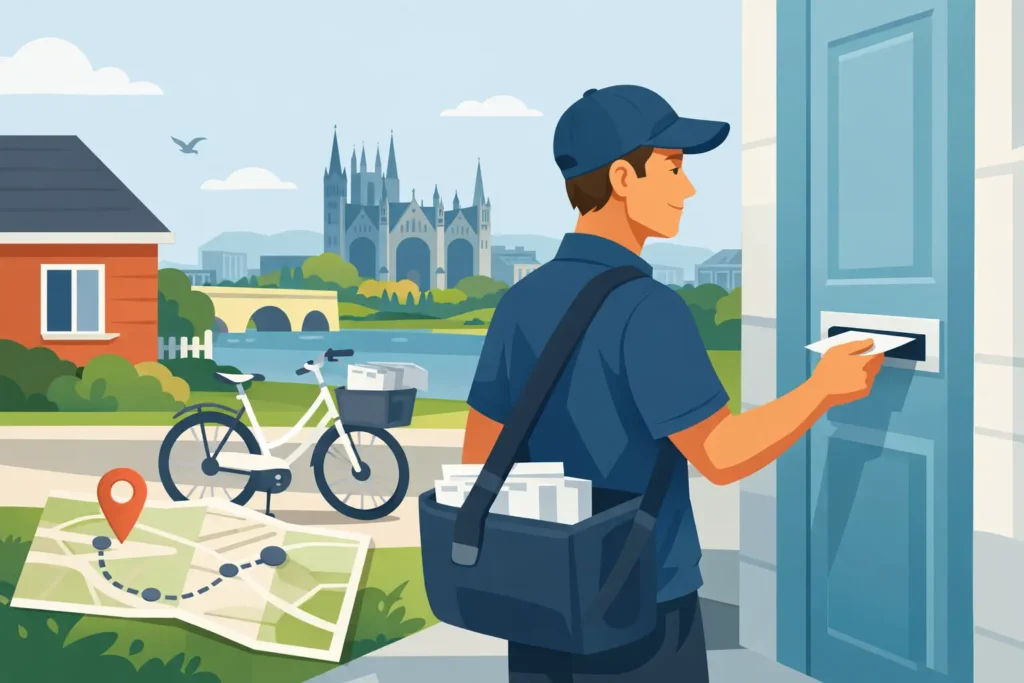
When someone searches for a leaflet distribution job in Peterborough, they are often looking at it from one of two angles. They may be searching for paid delivery work, or they may be trying to understand what the job actually involves before trusting a company with their campaign. For local businesses, the second point matters far more. If you are paying for door-to-door delivery, you need to know how the job works, what good standards look like, and where campaigns succeed or fail.
A leaflet campaign can look simple from the outside. Print the material, pick an area, send it out. In practice, the quality of the distribution job decides whether your print spend produces enquiries or disappears without trace. That is why businesses in Peterborough tend to ask practical questions first – who is delivering, how are routes planned, what areas are covered, and what proof is there that the campaign was completed properly?
A proper leaflet distribution job in Peterborough is not just a person posting flyers through doors at random. It is a planned local marketing operation with defined routes, delivery quantities, timing windows and area selection based on your commercial goals.
For example, a trades business may want concentrated household coverage in a small group of postcodes where call-out work is realistic and profitable. An event promoter may want wider reach in a shorter period to build fast local awareness. A restaurant launch may need repeated delivery in nearby residential streets rather than a broad campaign across every postcode sector.
The job, then, is part logistics and part targeting. Delivery teams need to follow mapped routes, handle the right quantities, and complete each round in the agreed timeframe. On the client side, the campaign needs to match the service area, the offer and the likely response rate. Good leaflet distribution is not about delivering everywhere. It is about delivering in the right places, in the right format, with enough control to protect your budget.
The biggest risk in leaflet marketing has never been print quality. It is trust. If a business owner pays for 10,000 leaflets to be distributed, they need confidence that those 10,000 items actually reach households.
That is where understanding the job behind the campaign becomes useful. Reliable distribution companies work with verified routes and clear reporting because those details address the main concern straight away. If routes are vague, reporting is weak, or coverage claims are broad and unsupported, the campaign becomes difficult to measure from the start.
This matters even more for businesses that rely on local response. A plumber, estate agent, takeaway, childcare provider or home improvement company does not need vanity numbers. They need calls, bookings and local recognition in the streets that matter to their business. If delivery standards are poor, even a strong leaflet design and offer can underperform.
There is a clear difference between organised campaign distribution and low-accountability delivery. The first is built around process. The second is usually built around price alone.
Professional distribution starts with area planning. That means looking at postcode sectors, housing density, access practicalities and quantity matching. It also means deciding whether shared distribution or solo delivery is the better fit. Shared delivery can be cost-effective when broad local reach is the goal. Solo distribution can make more sense when impact, exclusivity and message visibility matter more.
Then there is route control. Good campaign management depends on knowing where materials are going and when. A company that has worked Peterborough and surrounding sectors for years will usually understand how different neighbourhoods perform, where coverage is more efficient, and how to structure rounds sensibly.
Finally, there is reporting. Businesses should expect transparency, not guesswork. If a provider cannot explain how deliveries are monitored, that is usually a warning sign. Trust in leaflet marketing is built through proof, not promises alone.
Not every leaflet campaign should be run the same way. The right option depends on what result you want and how tightly you need to control spend.
If your priority is cost-efficient reach, shared distribution may be the sensible choice. It allows you to reach more households at a lower delivery cost, which suits awareness campaigns, general promotions and regular brand visibility.
If you are promoting a premium service, a time-limited event or a strong introductory offer, solo distribution often gives the message more presence. Your leaflet lands on its own, without competing directly with other printed material. That does not guarantee response, but it can improve attention.
Postcode targeting is equally important. A business covering PE1 to PE7 does not always need to deliver across all of it. In many cases, tighter targeting produces a better return. A local service provider may perform best in a few postcode sectors where travel time is manageable and brand recognition can be built quickly through repeated presence.
There is no single best format. It depends on your margins, your catchment area and the action you want households to take.
The question is not whether leaflet marketing works in theory. The question is whether a specific campaign is likely to work for your business.
Start with the economics. If one new customer covers a good share of the campaign cost, the channel may be commercially sound even with a modest response rate. This is often the case for trades, property-related services, home improvements, education providers and businesses with repeat customer value.
Then look at targeting. Broad distribution can work, but precision often improves efficiency. If your service is local by nature, focused area selection usually beats spreading your budget too thinly.
Timing matters as well. Seasonal offers, launches and event promotions need delivery windows that match buying intent. A leaflet delivered too early may be forgotten. Too late, and the opportunity has gone. The delivery job has to fit the campaign, not just the other way round.
Creative quality also plays a part, but businesses often overestimate design and underestimate distribution quality. A decent leaflet delivered reliably to the right homes will usually outperform an excellent leaflet delivered poorly.
National coverage can sound attractive, but local delivery knowledge is often more valuable when your aim is household response in a specific area. Peterborough is not one uniform market. Different neighbourhoods have different housing layouts, access patterns and campaign characteristics.
A provider with practical experience across local postcode sectors can advise more clearly on where quantity goes further, where repeat coverage makes sense, and how to phase campaigns if you want to test before scaling. That kind of planning protects budget and avoids the usual waste that comes from treating every area the same.
PB Leaflet Distribution has built its service around that principle since 2010 – local targeting, reliable execution and transparent reporting rather than vague coverage claims. For businesses investing in print, that level of accountability is not an extra. It is the basis of the campaign.
Before committing budget, ask direct questions. How are areas selected? What delivery format is recommended and why? What reporting is included? Is the campaign solo or shared? What timeframe is realistic for completion?
You should also ask whether the suggested quantity matches your objective. Bigger is not always better. If your business only serves a limited local radius, a smaller, more concentrated campaign may be the smarter option.
The best providers will answer these questions clearly. They will not bury the process in jargon or overcomplicate the decision. They will explain what is being delivered, where it is going, and how that aligns with your goal.
A leaflet distribution job in Peterborough is only worthwhile when it is planned and delivered properly. For local businesses, that means targeting homes with real potential, using a format that suits the offer, and working with a company that treats distribution as a measurable service rather than a vague marketing add-on.
If your business wants dependable local exposure, print still has a clear place. The key is not simply getting leaflets out. It is making sure the delivery job behind the campaign is reliable enough to turn print into real response. Start there, and the rest of the campaign has a far better chance of paying its way.
Ready to plan your next leaflet campaign?
Get a Free Quote
A leaflet campaign results example that shows what good response rates look like, what affects performance, and how…
Read article
A local flyer campaign booking guide for planning areas, quantities, timing and delivery options so your print marketing…
Read article
Need a PE7 leaflet distribution service you can trust? Reach the right homes with targeted delivery, clear reporting…
Read article