July 2, 2026
Best Times for Leaflet Campaigns
Find the best times for leaflet campaigns, from seasonal planning to weekly timing, so your delivery reaches homes…
Read article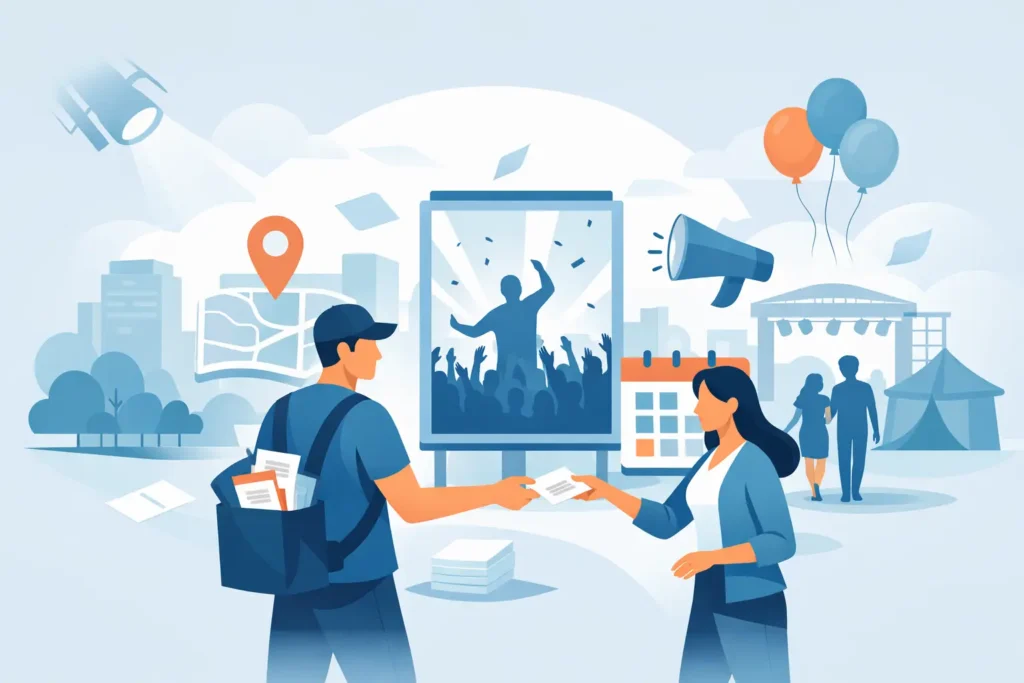
An event with a weak turnout rarely fails on quality alone. More often, the right people simply never heard about it in time. That is why leaflet distribution for event promotion still earns its place in a serious marketing plan, especially when you need local visibility, quick awareness and clear control over where your message lands.
For event organisers, venues and local businesses, print works best when the audience is nearby and the decision window is short. A resident may ignore a paid social advert in seconds, but a well-designed leaflet on the kitchen counter can stay in view for days. If the event is relevant, local and easy to act on, that repeated visibility matters.
Events are time-sensitive. You are not building awareness for the next six months. You are trying to create action within a fixed window. That changes how marketing should work.
Leaflets give you a direct route into households in the exact areas most likely to attend. That could mean families within a short drive of a school fair, homeowners near a showroom launch, or residents around a town centre event. Instead of paying for broad online reach and hoping the platform finds the right people, you decide which neighbourhoods to target and when the campaign lands.
This is where print has a commercial advantage. It is physical, local and selective. For many community events, retail promotions, seasonal launches and open days, that is often more useful than chasing impressions that never turn into footfall.
There is a trade-off, of course. Leaflet campaigns need planning. Design, print quantity, distribution area and timing all affect the result. If any one of those is off, response can drop. But when the campaign is built properly, print can produce strong attendance at a cost that remains manageable.
A common mistake is treating distribution as the whole strategy. It is only one part of the job. Before any route is planned, the event itself needs to be clear.
People respond to simple offers and specific reasons to attend. A leaflet that says “summer event” or “grand opening” without detail asks too much of the reader. A leaflet that says “Saturday 15 June, 10am to 3pm, free entry, live demos, exclusive one-day offers” gives them something concrete to act on.
That means your message should answer four questions quickly. What is happening, when is it happening, where is it happening, and why should anyone care? If the event has a clear benefit, such as free samples, limited-time discounts, entertainment, fundraising, expert advice or activities for children, that benefit needs to sit near the top.
Leaflet distribution performs better when the event proposition is already strong. If attendance has been poor in the past, the issue may not be the delivery method alone. Sometimes the offer is too vague, the timing is awkward, or the audience selection is wrong.
The main strength of leaflet distribution for event promotion is targeting. But local targeting only works when it matches how far people are willing to travel.
For a school fete, charity event, restaurant launch or family attraction, the best response often comes from a tight local radius. For a larger public event with a stronger draw, you can widen the net. The key is being realistic. Not every event deserves a town-wide campaign, and not every event should be promoted only on the nearest streets.
This is where postcode planning matters. In Peterborough and surrounding areas, a campaign can be shaped around specific postcode sectors rather than broad assumptions. That lets you focus spend where it is most likely to create attendance. If the venue sits near residential parts of PE1, PE2 or PE4, for example, those areas may give stronger value than distributing far beyond the likely catchment.
Audience fit matters just as much as distance. A children’s event is not targeted in the same way as a trade open day or evening business launch. The closer the area choice matches the people most likely to attend, the better your return on every thousand leaflets.
Even a strong leaflet in the right area can underperform if it arrives at the wrong time.
Most events need enough lead time for people to plan, but not so much that they forget. For many local events, one to two weeks before the date is a sensible starting point. If the event is larger, ticketed or tied to a weekend schedule, an earlier first wave may help, followed by a later reminder.
Short-notice campaigns can still work, particularly for promotions, pop-up events or weather-dependent activities, but the message needs urgency. If there is no obvious reason to act now, the leaflet can easily be set aside and forgotten.
There is also a balance between single and repeated exposure. One round may be enough for a straightforward local event. More valuable or competitive events often benefit from two touches, especially where turnout directly affects revenue. That second delivery can reinforce the date and improve recall.
A leaflet for an event is not a brand brochure. It needs to be read quickly and understood even faster.
That usually means a clear headline, a visible date and time, a precise location and one strong reason to attend. Too much text reduces impact. Too many design elements make the offer look less certain. The job is not to impress a designer. The job is to get someone through the door.
Good event leaflets also make response easy. If booking is required, say how. If it is a walk-in event, make that obvious. If there is parking, free entry, special guests or a limited-time offer, mention it clearly. Readers should not need to search for the basic information.
It also helps to think about the household setting. Your leaflet may be seen for ten seconds while someone sorts the post, or again later on a worktop. Strong layout, clean hierarchy and one main call to action usually beat crowded design every time.
This depends on the event, the budget and how much visibility you need.
Shared distribution is often the more cost-effective choice when the aim is broad local awareness. If you are promoting a community event, open day or standard retail launch, it can deliver sensible reach without pushing costs too high.
Solo distribution gives your leaflet the household’s full attention. That can be worth the extra spend for premium events, high-value launches, ticketed experiences or campaigns where every attendee has stronger commercial value. If one booking or one sale covers a meaningful share of the campaign cost, solo delivery becomes easier to justify.
There is no fixed rule. A lower-cost family event may not need solo distribution. A private event launch, wedding fair or showroom opening might. The decision should come back to expected value per attendee, not just print cost.
One of the biggest concerns in this sector is simple: were the leaflets actually delivered where they were supposed to go?
For event promotion, that question matters even more because there is limited time to correct a failed campaign. If the delivery is poor, the event date still arrives on schedule. You do not get that week back.
That is why reliable distribution, verified routes and transparent reporting are not add-ons. They are part of the result. A well-targeted campaign only works if the delivery is carried out properly. Businesses that run event marketing regularly tend to understand this quickly. Cheap distribution that cannot be trusted is rarely cheap in the end.
An experienced local distributor should be able to help with practical decisions too, from area selection to quantity planning and the best delivery format for the event type. That kind of operational clarity often matters more than sales talk.
Not every event campaign will produce perfect attribution, but you can still judge performance sensibly.
Look at attendance, bookings, enquiries, voucher redemptions or event-day offers claimed. If you include a unique response mechanism on the leaflet, measurement becomes easier. Even simple indicators, such as asking attendees how they heard about the event, can give useful feedback.
What matters is not chasing perfect data. It is learning enough to improve the next campaign. If one postcode area responds better than another, if a weekend delivery outperforms a midweek one, or if a clearer offer lifts turnout, those are commercially useful insights.
For local organisers and businesses, leaflet distribution for event promotion remains effective because it is practical. It gives you control over area, timing, quantity and format, and it puts your message in front of households that can actually attend. When the event offer is clear and the delivery is reliable, print does not need hype to prove its value. It just needs to get in front of the right doors at the right time.
Ready to plan your next leaflet campaign?
Get a Free Quote
Find the best times for leaflet campaigns, from seasonal planning to weekly timing, so your delivery reaches homes…
Read article
Learn how to choose leaflet areas for coverage with smarter local targeting, better timing and tighter budget control…
Read article
Need a trusted leaflet distribution company? Learn what to check, what proof matters and how to choose a…
Read article