June 16, 2026
Local Flyer Campaign Booking Guide
A local flyer campaign booking guide for planning areas, quantities, timing and delivery options so your print marketing…
Read article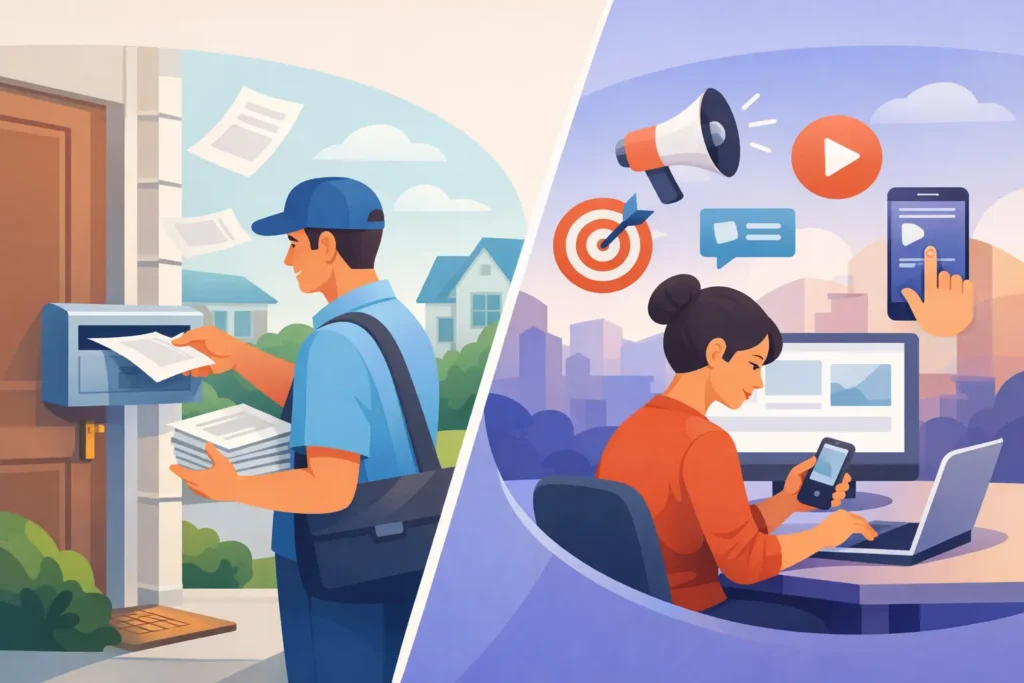
A local campaign can look good on paper and still fail for one simple reason – it reaches the wrong people in the wrong way. When businesses ask whether to choose leaflet delivery or digital ads, the real question is usually about control, response and wasted spend. If you need to reach households in a defined area and know where your marketing is going, the answer is rarely as simple as picking one channel and ignoring the other.
These two options do different jobs. Digital ads are built for speed, testing and quick visibility. Leaflet delivery is built for local coverage, physical presence and repeat exposure in the home. If you compare them only on headline cost, you can miss what actually drives enquiries.
A paid social advert can be launched in a day and adjusted by the hour. A leaflet campaign takes more planning, print and distribution. But once a leaflet arrives through the letterbox, it does not disappear with a scroll. It can sit on a kitchen worktop, get passed to another person in the household, or be kept until the customer is ready to act.
That difference matters for trades, local services, events, takeaways, estate agents, gyms and any business that depends on nearby households rather than a broad online audience.
Digital advertising is useful when speed matters. If you have a short-term offer, a last-minute event or a need to test multiple messages quickly, digital can give you fast feedback. You can change the headline, alter the spend and pause poor-performing campaigns without reprinting anything.
It also works well when your audience is already online and actively searching. A customer looking for an emergency plumber, same-day locksmith or local beauty treatment may respond well to paid search or social advertising because the intent is immediate.
The catch is that digital performance is not always as precise as it first appears. You can target by postcode, age or interests, but that does not guarantee attention. Ad fatigue is common. Clicks do not always turn into calls. And many small businesses end up paying for impressions in areas they do not really serve or for users who had no serious buying intent.
For some businesses, digital also becomes a management problem. Campaigns need monitoring, creative updates and a clear budget discipline. Without that, spend can drift without much to show for it.
Leaflet delivery gives you something many local firms still value highly – direct household coverage in the exact places you want to target. If your ideal customer lives in selected residential streets, postcode sectors or neighbourhoods, print can be far more straightforward than trying to replicate that coverage online.
That is especially true for services with a clear local footprint. A window cleaner, removals company, dentist, tutor or new takeaway often does not need county-wide awareness. They need visibility where their customers actually live.
A well-planned leaflet campaign also avoids one of the biggest frustrations in digital advertising: paying repeatedly just to stay visible. With print, your spend goes into physical distribution across a known area. The campaign has a beginning, a route and a measurable quantity. For many businesses, that feels more tangible and easier to budget for.
There is also a trust factor. People may ignore many online adverts without a second thought, especially if they look generic. A professionally designed leaflet delivered to the home can feel more established, more local and more deliberate. That does not mean every leaflet works. Poor design, weak offers and bad targeting still waste money. But when the message is clear and the area selection is right, print remains a strong route to local response.
Businesses often compare leaflet delivery and digital ads by asking which is cheaper. That is the wrong starting point. The better question is which one gives you lower wasted spend.
Digital can look cheaper at first because you can start with a small daily budget. But low entry cost does not always mean efficient results. If your advert reaches people outside your true service area, gets low-quality clicks or needs repeated spend to maintain visibility, the real cost rises quickly.
Leaflet delivery usually involves an upfront print and distribution cost, so the commitment is more visible. Yet that visibility can be a benefit. You know how many items are going out, where they are being delivered and when the campaign is scheduled. For local firms that want cost control and a defined area plan, that clarity matters.
This is where reliability becomes central. Print only works when the delivery is carried out properly. Businesses are right to ask how routes are verified, how areas are selected and what reporting is provided. The quality of distribution can make the difference between a strong return and a wasted print run.
Not every customer responds in the same way. If you are selling something urgent or highly searchable, digital may produce faster leads. If you are building local awareness, promoting a repeat-use service or introducing a business to residents in a specific area, leaflets often do more of the heavy lifting.
Think about how people buy. A homeowner may not need a gardener today, but they might keep a leaflet for two months and call when the weather changes. A family might see an advert for a local children’s activity online and forget it by evening, but a printed flyer on the sideboard can stay in view until booking day.
That delayed response is sometimes misunderstood as a weakness. In reality, it reflects how many local purchase decisions are made. Print is often less about instant clicks and more about staying present until the need appears.
For many businesses, the strongest answer is not leaflet delivery or digital ads, but how each channel supports the other.
Digital is good at capturing immediate attention. Leaflet delivery is good at building household familiarity in defined areas. Used together, they can reinforce one another. A resident may notice your leaflet, then search your business online later. Or they may see your advert online first and respond when a leaflet gives them a stronger reason to act.
This combined approach is often the most practical option for businesses launching in new areas, promoting seasonal offers or trying to increase response in selected neighbourhoods. Print establishes presence. Digital supports recall and follow-up.
That said, not every business needs both at once. If the budget is tight, the sensible choice depends on your objective. If you need broad testing and fast data, start with digital. If you need strong local penetration in a mapped area, start with leaflet delivery. If trust, coverage and postcode-level targeting are your priorities, print is usually the more dependable first move.
Start with geography. If your service area is tightly defined, leaflet delivery makes a strong case because it lets you focus spend where customers actually live. This is particularly useful for businesses targeting specific parts of Peterborough and nearby postcode sectors rather than trying to advertise across places they do not cover.
Then look at timing. Digital wins on speed and flexibility. Leaflets win on presence and staying power. If your offer needs action within 48 hours, digital may carry more weight. If you want local households to recognise your name over several weeks, print has a clear advantage.
Next, consider trust. Some services sell better when they feel established and local. A physical leaflet can support that. It shows you are serious enough to invest in the area. For many SMEs, that matters more than another online impression.
Finally, be honest about management. If you do not have the time or support to monitor digital campaigns properly, they can become expensive very quickly. A well-organised print campaign with verified delivery and clear reporting may be simpler to run and easier to measure against incoming enquiries.
PB Leaflet Distribution has built its service around that practical need – giving local businesses a reliable way to reach households with clear area targeting and accountable delivery.
If you want instant data, constant optimisation and short-term agility, digital ads are useful. If you want defined household reach, stronger local presence and more certainty over where your marketing goes, leaflet delivery is hard to beat.
Most businesses are not choosing between old and new. They are choosing between vague reach and controlled reach, between borrowed attention and physical visibility, between hoping the algorithm finds the right people and putting their message directly through the right doors.
That is the lens worth using. Pick the channel that gives you the clearest route to the customer you actually want, then commit to doing it properly.
Ready to plan your next leaflet campaign?
Get a Free Quote
A local flyer campaign booking guide for planning areas, quantities, timing and delivery options so your print marketing…
Read article
Compare cheap leaflet distribution options for local campaigns, from shared delivery to postcode targeting, and spend less without…
Read article
Understand door to door leaflet distribution cost, what affects pricing, and how to plan a reliable local campaign…
Read article