
June 6, 2026
When to Book Leaflet Distribution
Learn when to book leaflet distribution for better timing, coverage and response. Plan ahead for launches, offers, events…
Read article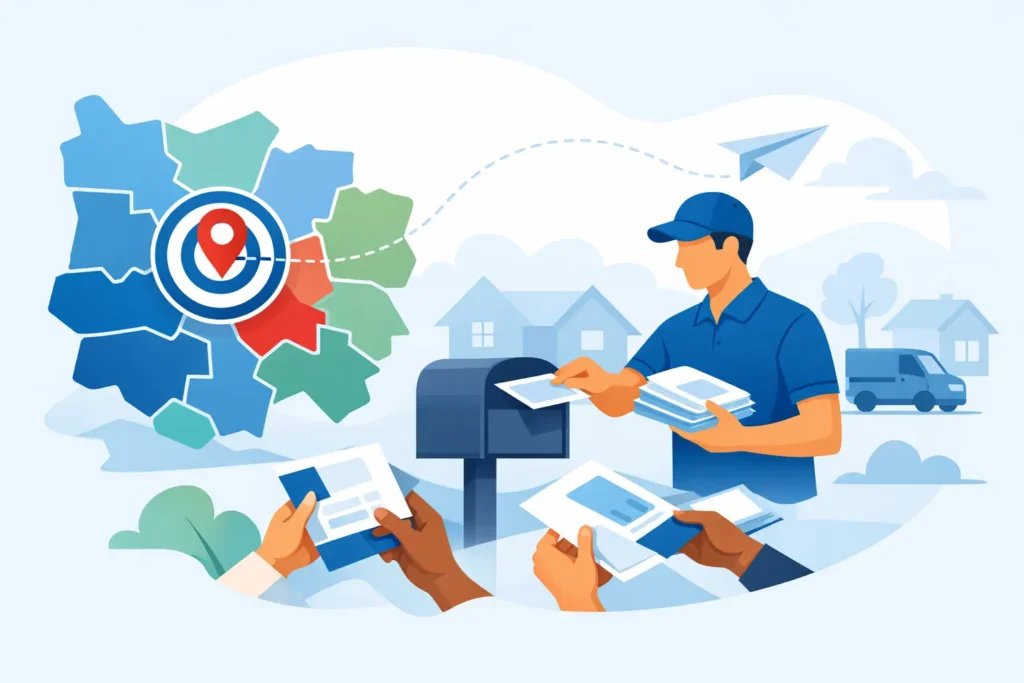
If you are paying to print 5,000 leaflets, the last thing you want is 5,000 random outcomes. Postcode targeted leaflet distribution gives you control over where your marketing goes, who is most likely to see it and how far your budget will stretch. For local businesses, that usually matters more than sheer volume.
A well-targeted print campaign is not about covering the biggest area possible. It is about reaching the right households at the right time with a message that fits the area. That might mean focusing on streets close to your business, postcode sectors where your ideal customers are more likely to live, or neighbourhoods that match a specific offer.
Postcode targeted leaflet distribution is exactly what it sounds like. Instead of delivering across a broad town-wide area, your campaign is planned around selected postcode districts or sectors. That gives you a tighter grip on coverage, cost and response.
For example, a takeaway launching a new delivery radius does not need households on the far edge of the city. A landscaping company might want larger residential areas with gardens rather than high-density flats. A new gym may focus on nearby commuter neighbourhoods where residents can realistically travel to the site. The value is in matching the area to the service, not simply moving paper from one letterbox to another.
This is where local knowledge matters. Postcodes may look neat on a map, but the reality on the ground is different. Some sectors are densely packed and efficient to cover. Others are spread out, mixed in housing type, or less suitable for a given offer. Good targeting starts with postcode selection, but it should not stop there.
Most businesses do not need blanket coverage. They need enquiries they can act on.
That is why postcode-based campaigns often outperform wider untargeted runs. You are not paying for households outside your catchment, outside your pricing comfort zone or outside the profile of customer you want. You are concentrating spend where it has the best chance of producing calls, bookings or footfall.
There is also a practical advantage. Tighter targeting makes testing easier. You can run one offer in PE1 and a different one in PE3. You can push one service in established residential areas and another in newer developments. If one area performs better, you can scale with more confidence next time.
That matters for smaller firms especially. Whether you are a tradesperson, estate agent, dentist, local retailer or event promoter, your marketing budget needs to work hard. A campaign that reaches fewer but more relevant households will often beat a larger campaign with weak targeting.
This approach works best when geography affects buying decisions. In local marketing, it usually does.
A service-based business may only cover certain areas profitably. An offer may only apply within a particular travel radius. A business opening a second site may want to build awareness in nearby neighbourhoods first, rather than spreading budget too thinly. Seasonal promotions can also benefit. A spring gardening campaign, for instance, may suit suburban family areas more than town-centre accommodation.
It also makes sense when you already know where your customers come from. If your best enquiries tend to come from two or three postcode sectors, that is a clear sign to target more precisely rather than distribute more widely.
The exception is brand awareness at a broad local level. If the goal is simple presence across a large territory, wider coverage may be the better fit. Even then, postcode planning still helps because it lets you phase the campaign sensibly instead of guessing.
The best area plan starts with your business model, not the map.
Ask where your customers can realistically come from, what type of housing suits your service and whether any neighbourhoods are already producing enquiries. A premium home improvement company, for example, may not choose the same areas as a discount cleaning service. An after-school club will care about family density. A local restaurant may care more about delivery range and repeat ordering.
In Peterborough and surrounding areas, this is particularly useful because postcode sectors can vary quite a bit in layout, housing mix and travel patterns. A campaign across PE1 to PE7 should not be treated as one uniform audience. Some areas are better for frequency, some for one-off launches and some for tightly defined local promotions.
There is always a trade-off between reach and precision. If you narrow the campaign too much, you may limit overall response volume. If you go too wide, you risk wasting budget. The right balance depends on your objective, your offer and what a successful response is worth to your business.
Targeting the right postcode is one part of the job. Choosing the right delivery format is the next.
Shared distribution is usually the cost-efficient option. Your leaflet is delivered alongside other non-competing items, which allows you to reach more households for less. For many local campaigns, especially awareness or general offer promotion, that is a sensible way to keep costs under control.
Solo distribution gives your leaflet the full moment of attention. It tends to suit stronger-value jobs, premium services, launch campaigns and messages where impact matters more than volume. It costs more, so the decision should come down to likely return rather than preference.
There is no universal winner. If you are promoting a low-margin offer, shared delivery may be the smart commercial choice. If one new customer is worth a substantial amount, solo delivery can justify the extra spend.
Leaflet distribution only works when it is actually carried out properly. That sounds obvious, but it is one of the biggest concerns buyers have, and rightly so.
A targeted campaign is only as good as its delivery. You can choose the perfect postcode sectors, print a strong design and plan the timing well, but if the distribution lacks accountability, the whole campaign becomes hard to judge. Poor delivery creates the illusion that print does not work, when the real issue is that the campaign was never given a fair chance.
That is why route verification and reporting matter. Businesses need confidence that selected areas were covered as agreed, on the schedule agreed, with quantities that make sense for the streets involved. Reliable delivery is not an extra. It is the foundation of any measurable result.
This is also why many firms choose experienced local providers rather than chasing the cheapest quote. Price matters, but trust matters more when you are investing in print, design and timing around a promotion.
Targeting gets you into the right letterboxes. The leaflet itself still needs to do its job.
The best campaigns are usually simple. One offer, one audience, one clear action. If you try to speak to everyone in every postcode with the same message, the campaign becomes vague. Strong local print marketing is more direct than that.
Timing matters too. A leaflet for emergency plumbing does not need the same lead time as one for an open day or seasonal sale. Repeat distribution can improve performance, especially in postcode sectors where awareness needs building over time. One pass may work for urgent services or strong offers, but many businesses get better results from planned repetition.
It also helps to track properly. Use a dedicated phone number if practical, a specific offer code, or ask new enquiries where they heard about you. Print is easier to assess when you build in a way to measure response from the start.
A practical postcode targeted leaflet distribution plan is usually built around four things: area, quantity, timing and format.
Area should reflect where the campaign is most commercially viable. Quantity should match the number of households in those selected sectors, not a rough guess. Timing should support the offer, whether that means a single push or repeated waves. Format should reflect the value of the campaign and the level of visibility required.
That may sound straightforward, but getting these four decisions right is where results are won or lost. Businesses often focus heavily on design and print while giving less attention to area planning. In reality, postcode choice can affect response just as much as the leaflet itself.
For companies that want a dependable local channel, that is the real advantage of working with a specialist. You are not just buying delivery. You are planning distribution in a way that makes commercial sense.
PB Leaflet Distribution has built its service around exactly that point – reliable area coverage, clear reporting and campaign planning that is based on where results are most likely to come from.
The strongest reason to use postcode targeting is not that it sounds more efficient. It is that it gives you a better chance of turning print spend into real enquiries.
You can focus on households that fit your service, avoid paying for low-value coverage and build campaigns around areas that are easier to serve and more likely to respond. That does not guarantee success every time. No marketing channel can do that. But it does put the odds in your favour.
If you want print advertising to be accountable, postcode targeted leaflet distribution is one of the clearest ways to make it so. Start with the areas that make the most business sense, test what works and build from there. That is usually where better results begin.
Ready to plan your next leaflet campaign?
Get a Free Quote
Learn when to book leaflet distribution for better timing, coverage and response. Plan ahead for launches, offers, events…
Read article
Leaflet distribution PE3 for businesses that want reliable local reach, targeted delivery, clear reporting and better response from…
Read article
How does leaflet distribution work? Learn how targeting, planning, delivery and reporting combine to help local campaigns reach…
Read article