

June 18, 2026
How to Measure Leaflet Response from Enquiries
Learn how to measure leaflet response from enquiries using simple tracking, better questions and practical reporting to judge…
Read article
Wasting 10,000 leaflets on the wrong streets gets expensive very quickly. If you want better response from print, you need to know how to target postcode areas based on where your customers actually live, what you are selling, and how far your service realistically stretches.
That sounds obvious, but plenty of businesses still choose coverage that is too broad, too random or too far from their trading area. The result is simple – higher print costs, lower response and less confidence in the channel. A postcode-based campaign works best when it is planned around commercial reality, not guesswork.
A targeted campaign gives you control. Instead of putting material through every available door, you can focus on the households most likely to respond. That matters whether you are promoting a local service, a short-term offer, a new opening or an event with a fixed catchment.
Postcode areas are useful because they give structure to your planning. You can line your distribution up with travel distance, service radius, demographic fit and budget. For many local businesses, that is far more practical than trying to build a campaign around broad towns or vague neighbourhood names.
It also makes measuring performance easier. If one postcode sector brings in stronger enquiries than another, you can repeat it, expand it or change your message. That kind of adjustment is much harder when your campaign area is unclear from the start.
The first step is to stop thinking in terms of maximum reach and start thinking in terms of useful reach. More households do not always mean better results. If you only work within a 15-minute drive, there is little value in paying to reach homes outside that range.
Start with your existing customer pattern. Look at where your best enquiries, repeat customers or most profitable jobs come from. Not just any customer – the right ones. A plumber may cover a wider area for emergency work than for boiler servicing. A gym may draw members from nearby estates but not from the far side of the city. A takeaway may get strong repeat orders in one sector and almost none in another.
That gives you a realistic base map. From there, match your distribution area to your offer. A premium service may perform better in selected residential streets than in a blanket campaign. A broad local offer, such as a family event or supermarket promotion, may justify wider coverage. It depends on what you are asking households to do and how easy it is for them to act on it.
Your real trading area is not the same as the area you would like to cover. It is the area where you can supply, serve or convert customers efficiently.
For local service businesses, this usually means looking at travel time, staff capacity and job value. If smaller jobs are only worthwhile close to base, keep those campaigns tight. If higher-margin work supports a larger radius, widen the target for that offer only.
For retail, hospitality and leisure, convenience matters. People are more likely to respond when the location feels local and easy to reach. That is why postcode targeting often works well for businesses that rely on regular household awareness rather than one-off impulse purchases.
A postcode district gives a useful starting point, but postcode sectors often make the campaign far sharper. There is a big difference between covering an entire district and selecting specific parts of it.
If you operate around Peterborough, for example, it can make more sense to select the right areas within PE1 to PE7 rather than treating the whole region as one market. Some sectors may be stronger for family services, others for home improvement, others for budget-led offers. The finer the targeting, the easier it is to control spend and reduce wasted delivery.
That does not mean every campaign should be ultra-narrow. If your leaflet carries a broad offer and your costs are built around volume, a wider area can still work well. The point is to choose that wider coverage deliberately, not by default.
Not every campaign has the same job to do. If you are trying to generate fast enquiries, you need areas where response is likely to happen quickly. If you are building local familiarity over time, consistency may matter more than immediate return.
A one-off opening offer often works best in a tight catchment around the business location. A seasonal campaign for home services may justify multiple adjoining postcode sectors if your team can cover them properly. An estate agent, nursery or trades business may benefit from repeat coverage in the same postcode areas rather than a single run across a much wider map.
This is where many campaigns go off course. Businesses spread budget too thinly, hoping to cover everywhere at once. In practice, repeated visibility in the right postcode usually outperforms scattered exposure across too many areas.
The strongest postcode plan usually combines location data, business logic and practical delivery planning.
You should look at distance from your premises, where current customers come from, average job value, likely household demand and whether your message fits the area. Timing matters too. If your campaign supports a time-sensitive promotion, choose areas you can cover properly within the right window.
It is also worth thinking about quantity. If your print run is fixed, you need to decide whether it is better to cover one area thoroughly or spread the volume more thinly. There is no universal rule here. A higher-value service often benefits from tighter targeting, while a mass-market offer may benefit from broader scale.
Postcode targeting is not only about drawing lines on a map. It is about choosing households that are more likely to care about what you are offering.
A premium landscaping service may perform better in areas with larger owner-occupied properties than in dense sections with limited outdoor space. A children’s activity provider may want strong family areas. A local restaurant may care less about property type and more about distance and convenience.
That is why postcode selection should always be tied back to the actual buying decision. Ask yourself a simple question: why would someone in this area respond now? If the answer is weak, the postcode probably is too.
Even the best targeting falls flat if the delivery is unreliable. Area selection and distribution quality have to work together. There is no point choosing strong postcode sectors if you cannot trust that the materials are being delivered where planned.
For that reason, businesses should look for clear route planning, transparent reporting and a service that can explain exactly how coverage is organised. Good targeting is only useful when the execution matches the plan.
This is especially important when you are testing postcode performance. If one area appears to underperform, you need confidence that the issue was the market, the message or the offer – not poor delivery. Reliability protects your budget and gives you better information for the next campaign.
The biggest mistake is choosing areas based on assumption alone. A business owner may think a certain part of town is ideal simply because it feels busy or familiar. That is not enough.
Another mistake is treating every postcode as equal. They are not. Response rates can vary widely between neighbouring areas, especially when the service, price point or audience is specific.
The third issue is trying to do everything in one run. If budget is limited, forcing a campaign across too many postcode areas usually reduces impact. It is often better to start with a focused test, review results and then scale the strongest sectors.
A final problem is ignoring operational limits. If a campaign brings in work from areas you cannot service efficiently, the headline response may look good but the actual return can suffer. Targeting should support profitable work, not just more enquiries.
If you want a practical approach, begin with three questions. Where do your best customers already come from? Which nearby postcode areas match that pattern? And how much coverage can your budget support without diluting the campaign?
From there, keep the plan straightforward. Choose postcode sectors that fit your service area, your offer and your likely response profile. Make sure the quantity is enough to create proper visibility. Then judge results by area, not by the campaign as a whole.
That is usually the difference between a leaflet campaign that feels hit and miss and one that becomes a repeatable marketing channel. A business that understands how to target postcode areas can spend with more confidence, test with less risk and build local presence where it actually counts.
If you are putting money into print, every street should have a reason to be on the plan.
Ready to plan your next leaflet campaign?
Get a Free Quote
Learn how to measure leaflet response from enquiries using simple tracking, better questions and practical reporting to judge…
Read article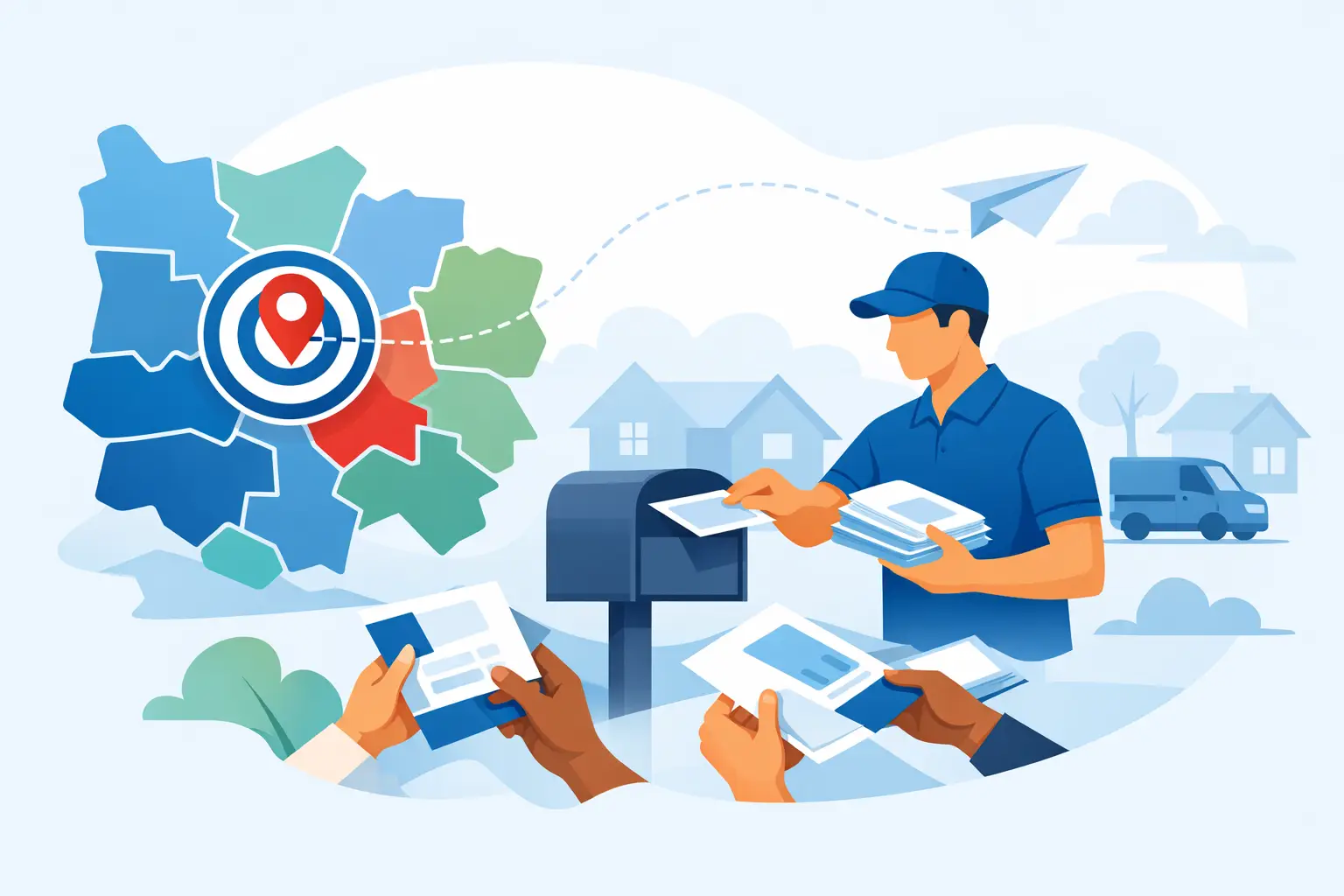
Postcode targeted leaflet distribution helps local businesses reach the right homes, control spend and improve campaign results with…
Read article
Learn how to choose leaflet areas for coverage with smarter local targeting, better timing and tighter budget control…
Read article